



You folded the laundry.
They cooked dinner.
The house looks balanced from the outside.
But in your head, there’s a running checklist no one else can see.
Did we confirm the school form?
Are we running low on groceries?
Is the doctor’s appointment still on Friday?
Why does it feel like you’re always on, even when nothing is happening?
This is the part of the partnership we rarely talk about, not the physical chores, but the invisible thinking behind them. The quiet planning. The emotional monitoring. The constant anticipation that keeps life running smoothly.
Physical chores can be listed, divided, and checked off.
Mental load doesn’t sit neatly on a to-do list; it lives in the background, shaping decisions long before any task begins.
And that’s exactly why it’s harder to share.
Why Physical Chores Are Easier to Share?
Physical chores are visible. You can see the dishes in the sink, the laundry basket filling up, or the floor that needs cleaning. Because these tasks are tangible, they feel easier to divide: you cook, I clean, you drive, I shop. There’s a clear beginning, a clear end, and often a visible result that makes the contribution easy to recognize.
Most couples grow up hearing about “splitting chores,” so creating balance around physical work feels familiar. Lists, charts, and routines work well because the tasks are concrete and measurable. When someone takes out the trash or folds clothes, the effort is obvious, and appreciation comes naturally.
But this visibility can also create an illusion of equality. While physical chores can be checked off a list, the anticipation and planning behind them often goes unnoticed. Someone still has to remember when groceries run out, decide what needs cleaning first, or anticipate tomorrow’s schedule. Physical tasks are easier to share because they live on the surface, while the thinking that powers them quietly stays in the background.
Why Does Mental Load Feel Harder to Split?
Unlike physical chores, mental load doesn’t show up as a single task you can hand over. It’s invisible. It’s a constant layer of thinking, anticipating, and adjusting, often invisible even to the person carrying it. That’s why sharing it feels more complicated than simply dividing chores.
- It Lives in the Background: Mental load doesn’t start and stop like washing dishes or doing laundry. It runs quietly in the background, while you’re working, resting, or even trying to switch off for the day. You might be relaxing on the couch, but your mind is already planning tomorrow’s schedule, remembering a school deadline, or mentally rearranging the week to make everything fit. Because it never fully “ends,” it’s harder to point to and say, this part is done.
- It’s Often Unspoken: Many partners don’t even realize how much invisible tracking is happening. One person may be keeping tabs on birthdays, groceries, appointments, emotional needs, and long-term plans, without ever saying it out loud. From the outside, it can look like everything is just flowing naturally. But behind the scenes, someone is constantly connecting the dots. When mental load isn’t named, it’s easy for it to go unnoticed and therefore, unshared.
- It Requires Initiative, Not Instructions: Primary caregivers often get asked by their partners, “Honey, just tell me what to do, and I’ll do it?” This makes primary caregivers the default owners of the invisible load. Sharing mental load isn’t about waiting to be told what to do. It’s about stepping into ownership, noticing what needs attention, planning, and making decisions without being prompted. When one partner always has to delegate or remind, the responsibility doesn’t actually shift. Real support happens when both people proactively take initiative, not just action.
- Emotional Labor Gets Mixed In: Mental load isn’t only about logistics, it’s also about emotional awareness. Noticing when someone feels overwhelmed, adjusting plans to avoid stress, keeping peace during busy weeks, or remembering what makes each person feel cared for. This emotional monitoring often blends into daily planning so seamlessly that it becomes invisible work. And because emotions are subtle, this part of the load is rarely acknowledged, even though it takes real energy.
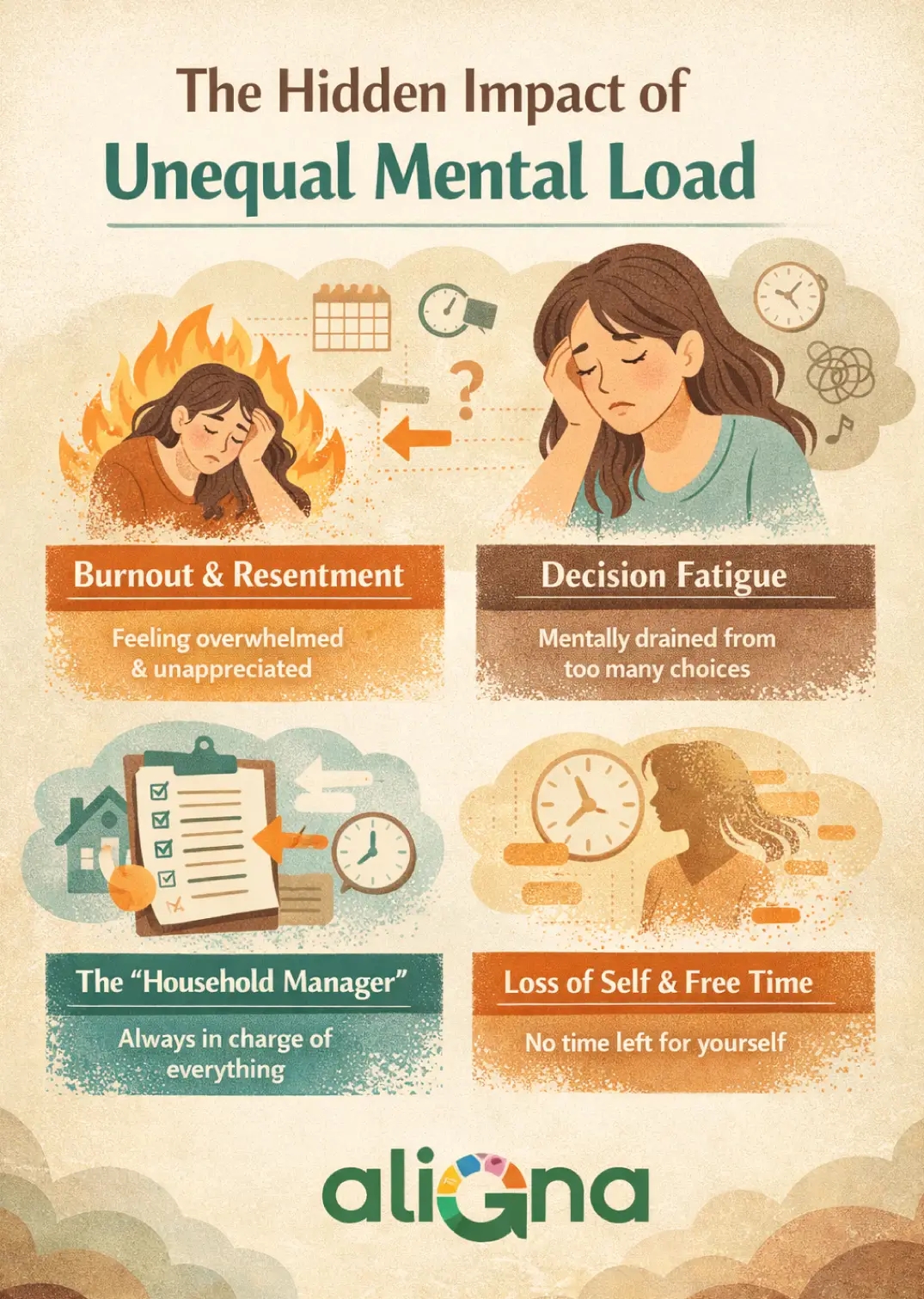
Signs You’re Carrying More Mental Load Than You Realize
Mental load doesn’t always feel obvious. Sometimes it just shows up as quiet exhaustion or the sense that your brain never fully switches off. If you’re wondering whether you’re carrying more than your share, these signs might feel familiar:
- You’re the default planner: Whether it’s vacations, meals, school schedules, special occasions, or weekend plans, you’re usually the one thinking ahead. Even when tasks are shared, the responsibility of figuring things out often lands with you.
- You remind everyone about everything: Deadlines, appointments, birthdays, bills, you’ve become the single source of truth- the human notification system. It’s not just about remembering for yourself, but the default load of keeping everyone else on track, too.
- You feel exhausted even when chores are shared: On paper, the division of physical work might look fair. But mentally, you’re still holding the bigger picture, anticipating problems, making decisions, and keeping things running smoothly. That invisible effort can be more draining than any single chore.
- You mentally track everyone’s needs: Who’s stressed this week? Who needs support? What’s running low at home? You’re constantly scanning the emotional landscape, adjusting plans before anyone even asks.
If these sound familiar, you’re not alone. Mental load often hides behind competence because when everything runs smoothly, it looks effortless from the outside.
How Couples Can Start Sharing the Mental Load?
Sharing mental load isn’t about perfection or keeping score. It’s about creating awareness and building systems that help both partners feel supported. Small shifts in how you communicate and organize daily life can make a big difference, without turning your relationship into a checklist.
- Make the Invisible Visible: You can’t share what you can’t see. Start by writing down all the planning work that happens behind the scenes, appointments, meal planning, school coordination, emotional check-ins, reminders, and follow-ups. When these tasks move from someone’s head onto a shared list, they become easier to understand and divide.
- Shift From “Helping” to “Owning”: There’s a big difference between helping and owning. Helping usually means waiting for instructions, while ownership includes noticing, planning, and following through. When one partner fully owns a responsibility, the other person doesn’t have to carry the mental burden of remembering or delegating.
- Weekly Mental Load Check-Ins: Long, emotional conversations aren’t always necessary. Sometimes, a simple weekly check-in can reset the balance before stress builds up. Set aside a few minutes weekly to ask questions like:
What’s coming up this week?
What feels heavy right now?
What can we shift or simplify?
Keeping these conversations short and consistent helps prevent resentment from growing quietly in the background. - Use Systems Instead of Memory: Mental load grows heavier when everything lives in one person’s head. Shared systems reduce the pressure to remember everything alone. Simple tools like shared calendars, planning frameworks, or family coordination systems can turn constant mental tracking into something visible and collaborative. Download our Free Chore Tracker to start better conversations about planning, ownership, and real partnership.

For a long time, conversations about relationship balance have focused on who does which chores. But true partnership goes deeper than dividing visible tasks; it’s about sharing the invisible thinking that keeps life moving. When both partners begin to notice, plan, and take initiative together, something shifts, not just in how tasks get done, but in how supported each person feels.
Real partnership begins with clarity, not assumptions.
If you’ve ever struggled to explain the invisible work behind everyday life, our Free Chore Tracker can help make planning visible and shared.
Use it as a simple tool to:
- Map out both physical chores and mental load
- Start honest, pressure-free conversations
- Move from “helping” to true ownership
Download the Free Chore Tracker and take the first step toward more balanced teamwork at home.