



Stop relying on one person to remember everything. Build a monthly planning system your whole family can actually see.
“Wait… that’s THIS weekend?”
It wasn’t supposed to happen.
The month started with the best intentions.
Summer camp was booked. Your daughter’s last day of school was on the calendar. You finally carved out time for lunch with your partner and promised yourself you’d visit Aunt Barbara before summer slipped away.
Then life happened.
A work presentation ran late.
The permission slip stayed on the kitchen counter.
The class treats never made it to school.
The eye appointment you’d already postponed twice quietly claimed the afternoon you had planned for yourself.
Somewhere between juggling work, parenting, and everyday life, the month started managing you instead of the other way around.
If this sounds familiar, here’s something important to know:
You probably don’t have a planning problem.
You have a visibility problem.
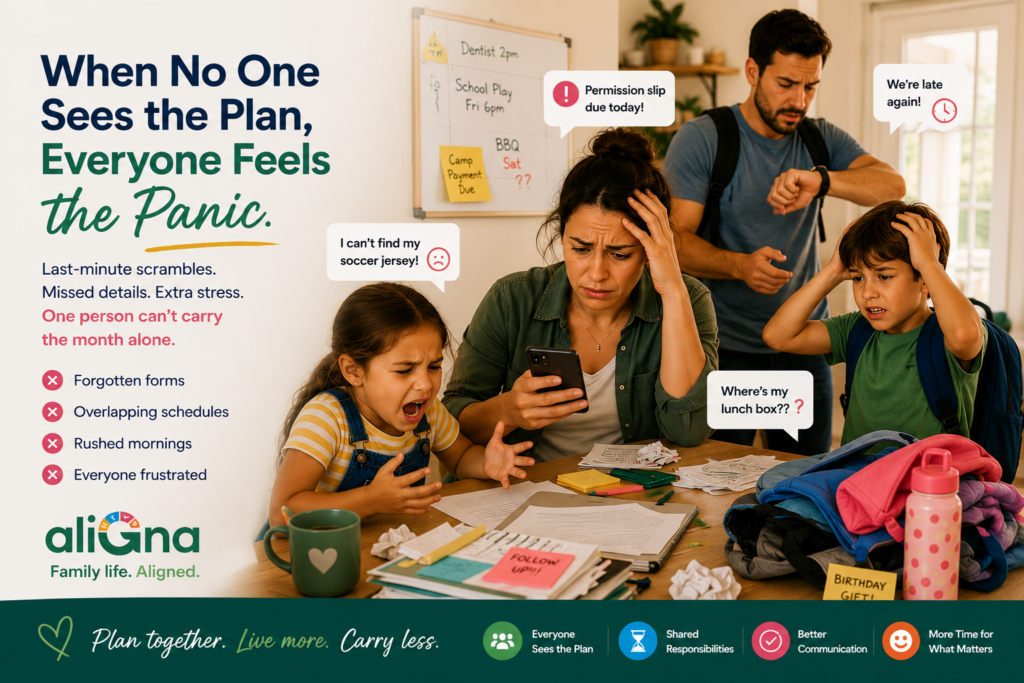
One person is carrying the month.
Everyone else is living in it.
Why Family Planning Feels So Overwhelming
When families feel overwhelmed, the first instinct is usually to find a better calendar.
A bigger wall planner.
More reminders.
Another productivity app.
A color-coded schedule.
But the calendar was never the real problem.
The real problem is that one person becomes responsible for remembering everything.
Not just the appointments.
The preparation.
The follow-ups.
The tiny details that never make it onto the calendar but somehow always need to happen.
Someone remembers:
- The permission slip due Friday.
- The camp payment due next week.
- The birthday gift that still needs to be ordered.
- The groceries for the neighborhood barbecue.
- The sunscreen before the beach trip.
- The snacks for soccer practice.
- The prescription that needs to be refilled.
None of these appear as calendar events.
Yet they all live somewhere.
Usually inside one person’s mind.
This is what researchers and families increasingly recognize as the mental load—the invisible work of planning, remembering, anticipating, and coordinating that keeps family life moving.
The Calendar Was Never Missing. The Memory Was Never Shared.
That’s the shift.
A calendar tells you when something happens.
It rarely tells everyone:
- Why it matters.
- What needs to happen beforehand.
- Who owns each responsibility.
- What still hasn’t been done.
One person quietly connects all of those dots.
Month after month.
Eventually, they don’t just manage the calendar.
They become the calendar.
What Healthy Family Planning Actually Looks Like
A well-planned month isn’t one where every hour is scheduled.
It’s one where everyone understands what’s coming.
Everyone knows what they’re responsible for.
Everyone has enough context to contribute without waiting to be reminded.
Because family planning isn’t about organizing one person’s life.
It’s about creating a shared understanding of family life.
When everyone can see the same picture, no one has to carry it alone.

5 Ways to Plan Your Family’s Month Without the Last-Minute Panic
1. Start Every Month with a 15-Minute Family Planning Meeting
Before the month begins, gather everyone together.
Review:
- School events
- Sports and extracurricular activities
- Doctor and dental appointments
- Birthdays
- Family celebrations
- Work travel
- Weekend plans
- Personal time you want to protect
The goal isn’t perfection.
It’s making sure everyone starts the month with the same roadmap.
2. Plan the Work Behind Every Event
An appointment isn’t just one hour on the calendar.
It’s also:
- Completing paperwork.
- Finding the insurance card.
- Leaving work early.
- Packing what you need.
- Scheduling the follow-up visit.
Write down the preparation—not just the event.
Invisible work becomes shared work once everyone can see it.
3. Assign Ownership Instead of Sending Reminders
There’s a big difference between reminding someone and giving them ownership.
Instead of saying,
“Don’t forget the barbecue groceries.”
Try saying,
“You’re in charge of everything we need for Saturday’s barbecue.”
Ownership builds confidence.
Shared ownership builds trust.
And trust reduces the mental load for everyone.
4. Schedule a Five-Minute Mid-Month Reset
Life changes.
Practice gets rescheduled.
A school email changes pickup times.
A birthday invitation appears.
A quick family check-in halfway through the month helps everyone adjust before small surprises become stressful emergencies.
Five minutes now saves hours later.
5. Leave Room for the Moments You Can’t Plan
Not every square on the calendar needs to be filled.
Some of the best family memories happen when nothing was scheduled.
A spontaneous bike ride.
Ice cream after dinner.
Watching fireworks from the backyard.
A slow Saturday morning.
Planning isn’t about squeezing more into your month.
It’s about creating more room to enjoy it.
The Goal Was Never a Perfect Calendar
One day, your children won’t remember whether the extra towels made it into the beach bag.
They won’t remember who picked up the hamburger buns.
Or whether every appointment happened exactly on time.
They’ll remember that you were there.
Laughing.
Listening.
Watching the fireworks instead of mentally rehearsing tomorrow’s to-do list.
That’s what planning is really for.
Not perfect calendars.
More presence.
More connection.
More moments that become lifelong memories.
Family Planning Shouldn’t Depend on One Person
At Aligna, we believe families don’t need another calendar.
They need a shared family operating system.
One place where everyone can see what matters, understand what’s needed, and contribute with confidence.
Because family life was never meant to live inside one person’s head.
When planning becomes shared…
Families become more connected.
Parents become less overwhelmed.
And everyone gets more time for what matters most.
Before You Go…
Ask yourself one simple question:
What’s one thing you’ve been carrying in your head this month that the rest of your family doesn’t even know exists?
Start there.
One conversation.
One shared responsibility.
One small shift.
That’s often how a calmer month begins.
Ready to Carry Less Together?
Imagine opening your monthly plan and realizing you’re no longer the only person who knows what needs to happen.
That’s the future we’re building at Aligna.
Join our beta community and help shape a better way for families to plan, communicate, and share the mental load.
👉 Join the Aligna Beta Community at https://usealignaapp.com