

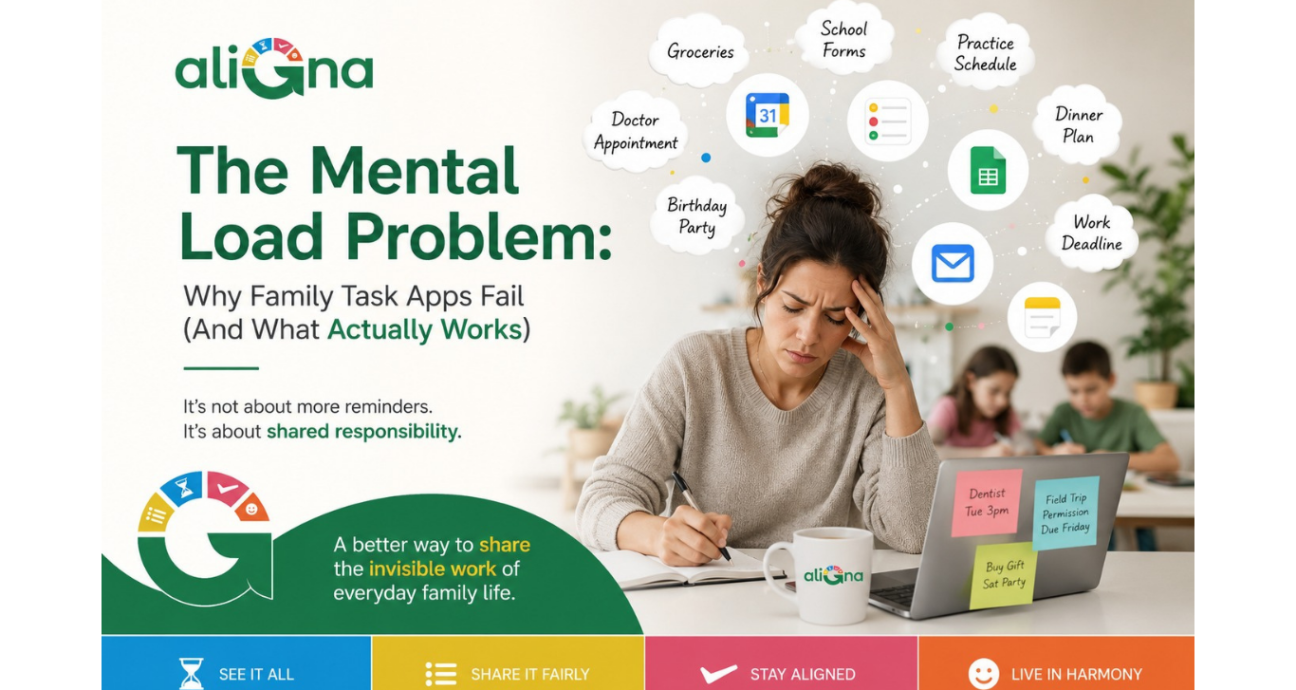
The problem was never your checklist. It was asking one person to carry the invisible work behind it.
In This Article
If you’ve ever wondered why your family still feels overwhelmed despite using shared calendars, reminder apps, and digital to-do lists, you’re not alone.
Most family task apps are excellent at organizing tasks. What they don’t organize is the invisible work of anticipating, remembering, coordinating, and carrying responsibility for everyday family life.
In this article, you’ll learn why traditional family organization apps often fall short, what mental load really means, and what families actually need to reduce stress, strengthen partnership, and share responsibility more fairly.
Quick Answer
Why do family task apps fail?
Family task apps organize tasks, but they don’t distribute the invisible responsibility of planning, anticipating, remembering, and coordinating everything those tasks require. Reducing mental load requires shared ownership, context, and awareness—not simply better reminders.
The checklist was never the problem.
You downloaded the app.
Built the lists.
Color coded everything.
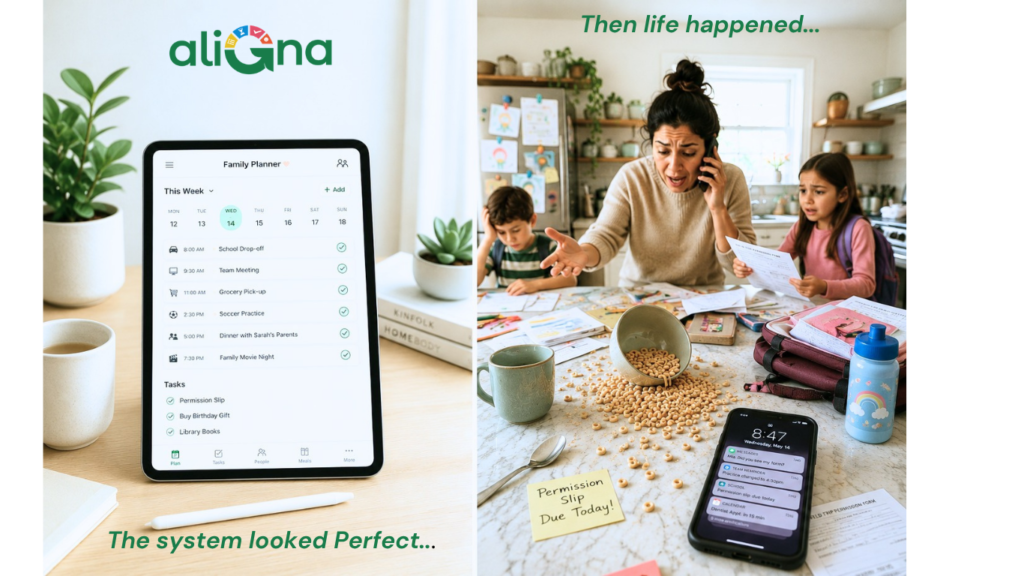
For a week, it felt like this time might be different.
The reminders were set.
The calendar looked beautiful.
The checkboxes were satisfying.
Then life happened.
The dentist appointment moved.
Someone outgrew their soccer cleats.
The permission slip never made it out of the backpack.
The birthday party invitation arrived two days late.
And somehow…
You were still the one remembering everything.
Not because the app failed.
Because it was never designed to carry what families actually carry.
Most family task apps are built to organize tasks—not reduce the invisible mental load of running a household.
What You’ll Learn
By the end of this article, you’ll understand:
- Why checklists alone don’t reduce mental load
- The difference between completing a task and owning a responsibility
- Why invisible work creates relationship stress
- What modern family technology should actually solve
- How shared ownership leads to healthier partnerships at home

What Is Mental Load?
Mental load is the invisible work required to keep a household running smoothly.
It includes anticipating needs before they become urgent.
Remembering appointments.
Planning ahead.
Coordinating schedules.
Tracking deadlines.
Managing emotional expectations.
Thinking three steps ahead so everyone else can stay in the present.
Unlike household chores, mental load is often invisible. It happens long before anyone washes the dishes, packs the lunch, or drives to soccer practice.
Research consistently shows that this invisible planning and coordination continues to fall disproportionately on one partner, even in households where both adults work full time.
Why Checklist Dont Solve Mental Load
Most family task apps do one job well.
They organize tasks.
They remind you when something is due.
They let you check a box.
That is exactly what they were built to do.
Families need something different.
A household isn’t just a collection of tasks.
It’s hundreds of connected decisions, emotions, conversations, and moments of anticipation.
Research consistently shows that the invisible planning, remembering, and coordinating behind family life continues to fall disproportionately on one partner, even in households where both adults work full time.
A checklist doesn’t know that Tuesday’s dentist appointment means someone has to leave work early.
It doesn’t know that “buy birthday gift” actually means:
- Figure out what an eight year old is interested in this month.
- Check the class invitation.
- Order the gift before shipping deadlines.
- Wrap it.
- Find batteries.
- Write the birthday card.
- Remember to bring it.
The task was never “buy a gift.”
The task was carrying all seven steps.
And the hardest part isn’t doing the task.
It’s anticipating the task before anyone else realizes it exists.
Families don’t become overwhelmed because there are too many checklists.
They become overwhelmed because one person is constantly looking three steps ahead for everyone else.
A Conversation I’ll Never Forget
During one customer interview, I asked a mother how many apps she used to manage her household.
She laughed.
Then she started counting.
Three calendars.
Six school and sports apps.
A grocery app.
An email folder just for school.
Sticky notes.
Texts.
A notes app.
Halfway through she stopped.
“I honestly don’t know anymore.”
Then she smiled.
“It all still lives in my head.”
That wasn’t a technology problem.
It was a mental load problem.
And it’s a story we’ve heard again and again from families across our research.
One partner has three calendars.
Two reminder apps.
A system of sticky notes that somehow makes perfect sense.
The other partner finds out today is a half day at school.
At pickup time.
Both love their family deeply.
Only one of them is holding the map.
Nothing has gone wrong.
The system is working exactly as it was designed.
The problem is…
It was never designed for families.
Why Family Task Apps Fall Short?
Because they capture tasks.
Not ownership.
A checklist can tell you that “Pack the swim bag” hasn’t been completed.
It can’t tell you why it’s always the same person remembering to pack it.
Visibility isn’t the same as fairness.
A shared list that only one person mentally owns isn’t actually shared.
It’s simply witnessed.
What Modern Family Organization Apps Need Instead
Families don’t need more reminders.
They need better systems.
Context
Every task has a story.
Without context, people complete actions without understanding responsibility.
Ownership
Real ownership means someone notices.
Plans.
Prepares.
Follows through.
Not just checks a box.
Awareness
A good system helps everyone understand what’s happening before problems appear.
Emotional Weight
Some tasks take five minutes.
Some tasks take five minutes and carry three days of quiet worry.
Families feel that difference.
Checklists don’t.
What Actually Reduces Mental Load?
Mental load doesn’t become lighter because tasks are organized.
It becomes lighter because responsibility is shared.
Imagine a system that doesn’t just remind people.
It helps everyone understand what’s happening.
It notices patterns.
Suggests ownership.
Makes invisible work visible.
Creates awareness without blame.
Encourages teamwork without keeping score.
That’s what families have been asking us for.
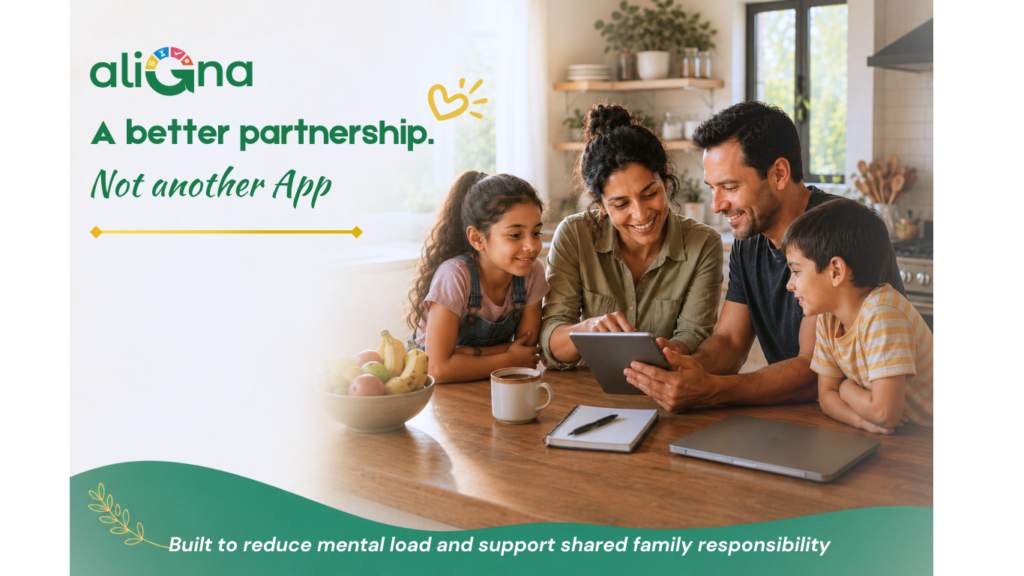
Not another productivity app.
A better partnership.
Across surveys, interviews, online communities, and conversations with parents, we kept hearing the same message:
“I don’t want to organize my mental load better.”
“I want to share it.”
The Future of Family Technology
The next generation of family technology won’t be measured by how many tasks it manages.
It will be measured by how much stress it removes.
The best family systems won’t replace conversations.
They’ll make better conversations possible.
They won’t replace partners.
They’ll help partners show up for each other.
Because the goal was never a longer checklist.
It was a lighter one.
Shared by more than one mind.
Key Takeaways
- Family task apps organize actions but rarely distribute responsibility.
- Mental load is about anticipation, coordination, and ownership—not just reminders.
- Invisible work becomes easier to share when everyone can see it.
- Better family systems strengthen partnership, not just productivity.
- The goal isn’t to manage more tasks. It’s to help families carry less together.
Frequently Asked Questions
Why don’t family task apps reduce mental load?
Most task apps organize actions, but they don’t make invisible planning, remembering, and ownership visible across the household. Mental load is about responsibility, not just checklists.
What is invisible mental load?
Invisible mental load is the ongoing thinking required to run a household. It includes anticipating needs, remembering appointments, planning ahead, coordinating schedules, and carrying emotional responsibility that often goes unnoticed.
Is mental load the same as household chores?
No. Chores are the visible work of maintaining a household. Mental load is the invisible work of anticipating needs, planning ahead, remembering details, and coordinating family life before the chores even begin.
What is the difference between mental load and household tasks?
Household tasks are the visible, physical actions like cooking dinner, doing laundry, driving to school. Mental load is the invisible infrastructure behind those actions: planning, anticipating, remembering, and coordinating. You can complete every task on the list and still carry the full mental load if you’re the only one thinking about what needs to happen next.
What should a family organization app do?
A modern family organization app should help families share ownership, provide context, reduce mental load, and encourage teamwork instead of simply tracking tasks.
Why do shared calendars still leave one partner overwhelmed?
Shared calendars display events, but they don’t distribute responsibility for planning, preparing, or anticipating everything those events require. One person often continues carrying the mental responsibility behind the schedule.
What is a household operating system?
A household operating system goes beyond calendars and to-do lists by helping families organize information, clarify ownership, coordinate responsibilities, and make invisible work visible so it can be shared more fairly.
How can couples share the mental load more fairly?
Sharing the mental load starts with making invisible work visible. When both partners understand what needs to happen and who owns it, responsibility becomes shared instead of managed by one person.
Help Build the Future of Family Life
We’re building Aligna alongside families who are ready for something different.
Not another to do list.
Not another calendar.
A better way to share the invisible work of everyday life.
If this story felt familiar, we’d love for you to help shape what’s next.
Join families helping build a household operating system designed to reduce mental load, strengthen partnership, and bring more harmony to everyday life.
Because the best family technology shouldn’t be built for families.
It should be built with them.
About the Author
Reddhi Patel is the founder of Aligna, an AI-powered household harmony platform designed to reduce the invisible mental load of family life. Through customer research, interviews with parents, and her own experience as a working mother, she writes about family coordination, household systems, and the future of family technology.
Continue Reading
You might also enjoy:
- How to Plan Your Month as a Family (Without Last-Minute Panic)
- How to reduce mental load during summer( without doing more)
- How to talk to your partner about mental load
- The hidden mental load of managing school holidays