


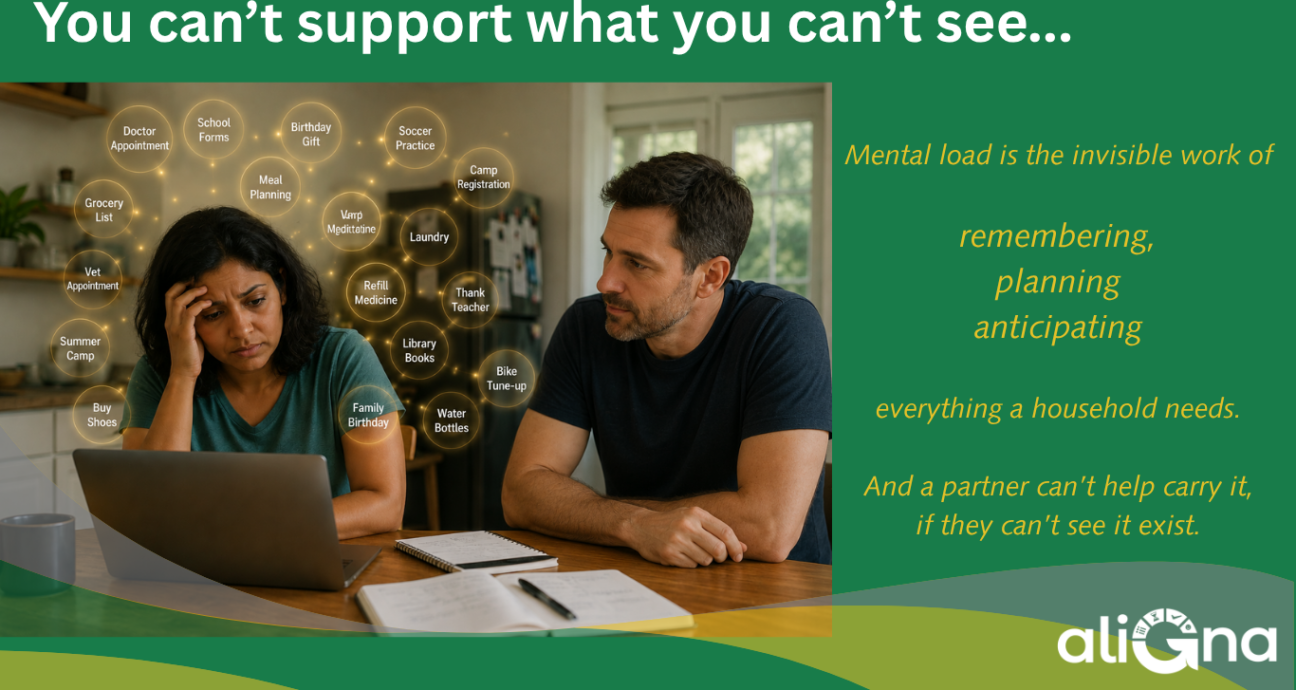
You Can’t Support What You Can’t See
Every family has invisible work.
Someone remembers the dentist appointment before anyone else does.
Notices the milk is almost gone.
Knows the birthday gift needs to be ordered before Friday.
Keeps a mental list of a hundred little things that never make it onto the family calendar.
Usually, no one notices who’s remembering all of it.
That’s the mental load.
Research helps explain who tends to carry it. A study of nearly 3,000 U.S. parents found that primary caregivers shoulder approximately 71% of the household’s cognitive labor, even in dual-income households.
Recently, our founder, Reddhi Patel, sat down with Liisa Reimann on the show SHEnanigans to talk about why she built Aligna.
It wasn’t a product pitch.
It was a conversation about motherhood, marriage, and the particular kind of exhaustion that comes from carrying an entire household in your head.
One idea from that conversation has stayed with us.
You can’t support what you can’t see.
It sounds simple.
It explains almost everything.
What Is Mental Load, Really?
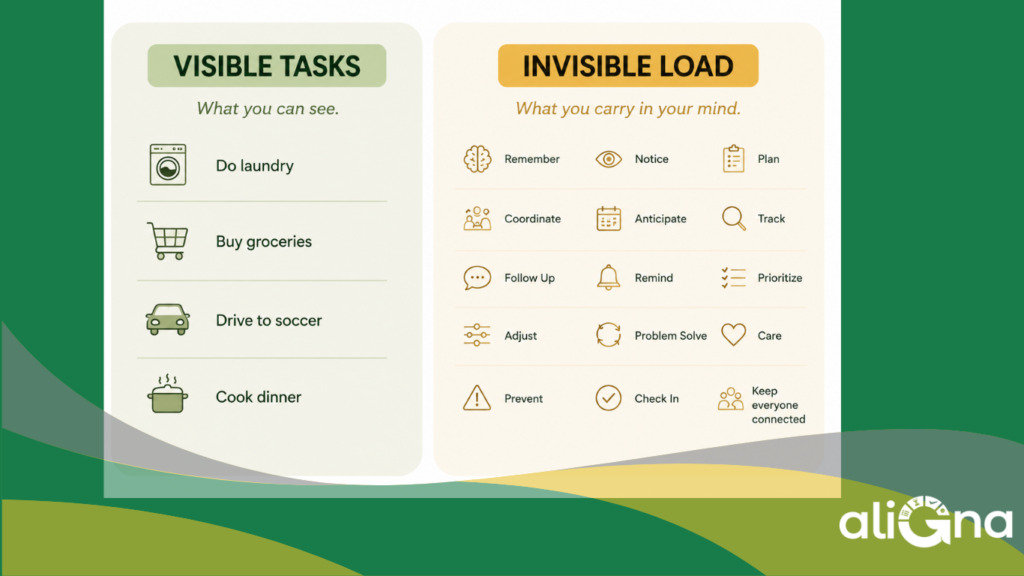
Mental load isn’t the laundry, the school forms, or the grocery list itself.
It’s the invisible work happening around those tasks.
It means:
- Remembering what needs to be done.
- Anticipating problems before they happen.
- Planning when and how everything gets done.
- Coordinating who owns each responsibility.
- Emotionally monitoring how everyone in the household is actually doing.
It’s a quiet operating system running in the background of one person’s mind. All day, every day.
When Reddhi became a mother, she started noticing this pattern everywhere.
Not only in her own home.
But in conversation after conversation with other parents.
It wasn’t a lack of love.
It wasn’t a lack of effort.
It was a lack of visibility.
Why Doesn’t “Just Ask for Help” Work?
This is the paradox at the center of the mental load conversation.
Most partners genuinely want to help.
But it’s difficult to take ownership of responsibilities you can’t see coming.
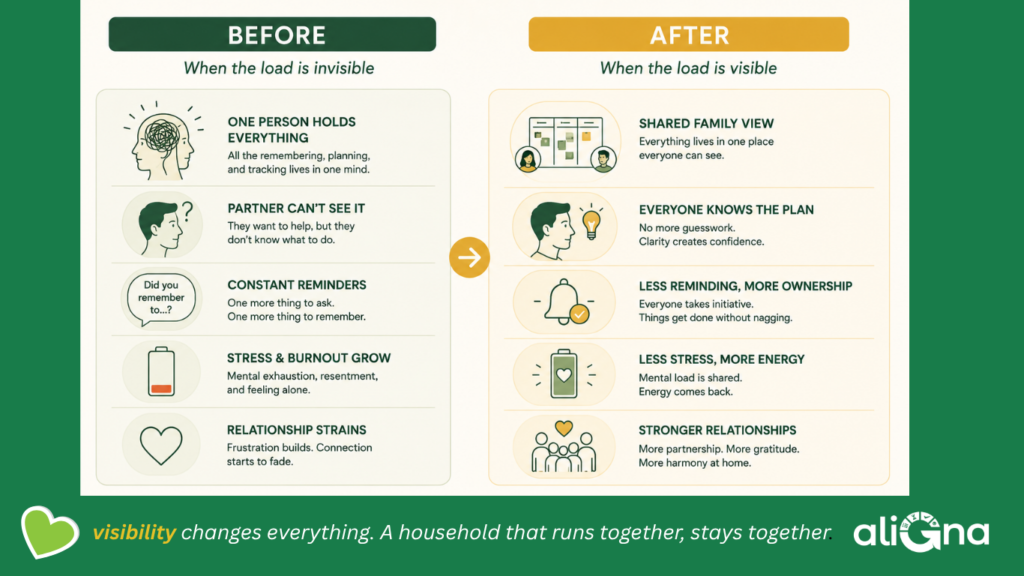
If one partner has to constantly remind the other about appointments, school forms, birthday gifts, groceries, and everything else, they haven’t actually shared the responsibility—they’ve simply added “household project manager” to their list of jobs.
Nobody wants to be responsible for reminding someone else to remember.
That’s not a communication problem.
It’s a systems problem.
When responsibilities live inside one person’s mind instead of somewhere shared, the only way to distribute them is to continually narrate them out loud.
And narrating the household all day is exhausting.
Families don’t struggle because they lack commitment.
They struggle because they’re relying on memory instead of shared systems.
What Does “You Can’t Support What You Can’t See” Mean for a Family?
For Reddhi, it meant something very personal.
Her husband wanted to be an equal partner.
He wasn’t choosing not to help.
He simply couldn’t see the hundreds of small threads she was quietly holding together because none of them existed anywhere they could both see.
Once those responsibilities became visible—even in a simple shared way—the dynamic changed.
Not because he suddenly cared more.
Because he finally had something he could genuinely own.
That simple shift became the foundation for Aligna.
Our belief is straightforward:
When invisible work becomes visible, responsibility can finally become shared.
Why Visibility Matters More Than Another To-Do List
Most family organization apps focus on managing tasks.
Aligna was built to help families share responsibility.
Traditional productivity tools assume someone is already keeping track of everything.
Aligna asks a different question:
What if no one had to carry the entire household in their head?
Instead of relying on one person’s memory, Aligna creates shared visibility so everyone understands what needs attention before someone has to ask.
Because relationships become healthier when responsibility becomes visible.
How Do Families Avoid Burning Out?
Families who rely on one person’s memory eventually reach a breaking point.
As the saying goes, you can’t pour from an empty cup.
You can’t put someone else’s oxygen mask on before your own.
The answer isn’t doing more.
It’s making invisible work visible enough that it can be shared not delegated one task at a time, but genuinely owned by more than one person.
There’s No Manual for This
Parenting books teach feeding schedules, developmental milestones, and sleep routines.
Very few teach the logistics of running a household.
The appointments.
The permission slips.
The birthday invitations.
The groceries.
The endless mental spreadsheet that quietly keeps family life moving.
Over the past several years, Reddhi interviewed and surveyed more than 140 families across the United States.
Regardless of income, profession, or family structure, the same pattern kept appearing:
One person was quietly carrying most of the invisible work.
Those conversations didn’t just inspire Aligna.
They shaped how it was designed from the very beginning.
No manual.
No shared system.
Just one person quietly holding everything together.
That’s the gap we’re working to close.
Frequently Asked Questions
What is mental load?
Mental load is the invisible cognitive work involved in remembering, planning, anticipating, coordinating, and managing everything required to keep a household running.
Why do mothers often carry more mental load?
Research consistently shows that mothers tend to carry a larger share of household cognitive labor, even in dual-income families. This often includes anticipating needs, coordinating schedules, and managing responsibilities that extend far beyond physical chores.
Can mental load actually be shared?
Yes. Mental load becomes easier to share when responsibilities are visible to everyone instead of living inside one person’s memory. Shared visibility allows family members to take ownership without waiting to be asked.
Why do couples argue about chores?
Many disagreements aren’t really about chores, they’re about the invisible planning, remembering, and coordinating behind those chores. When one partner carries most of that cognitive work, resentment often builds over time.
Watch the Full Conversation
If this story resonated with you, we invite you to watch Reddhi’s full conversation with Liisa Reimann on SHEnanigans.
It isn’t just a conversation about building a startup.
It’s a conversation about building healthier relationships by making invisible work visible.
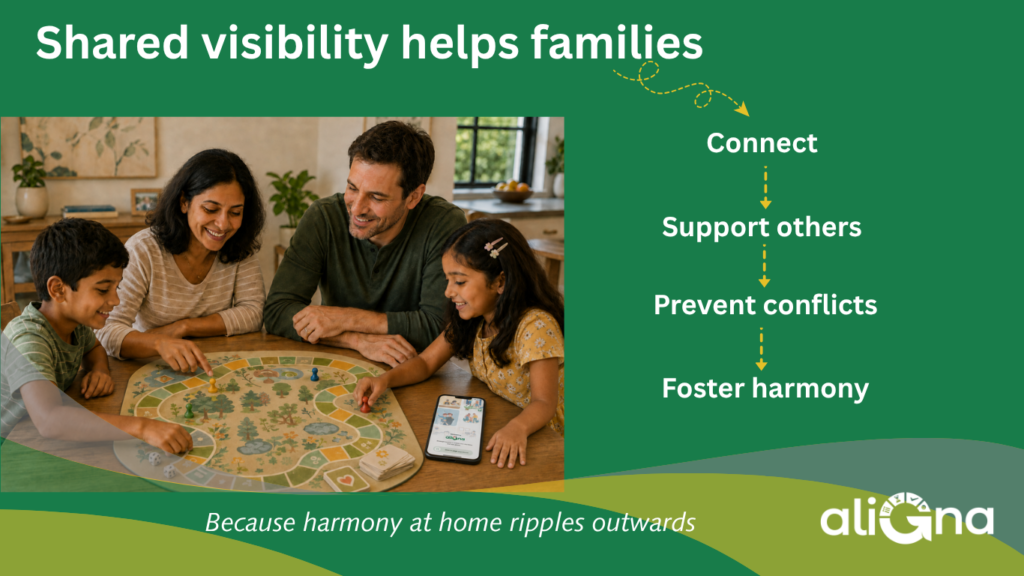
If you’re tired of carrying the invisible work alone—or you’re a partner who genuinely wants to help but doesn’t always know how—you’re exactly who we’re building Aligna for.
Together, we’re creating a future where families run on shared clarity, not one person’s memory.