


Short answer: a back-to-school checklist shows the visible tasks. What it doesn’t show is the mental load behind them. Anticipating what will be needed, finding information, remembering details, making decisions and following up until everything actually happens.
And increasingly, that invisible work lives across a screen full of apps.
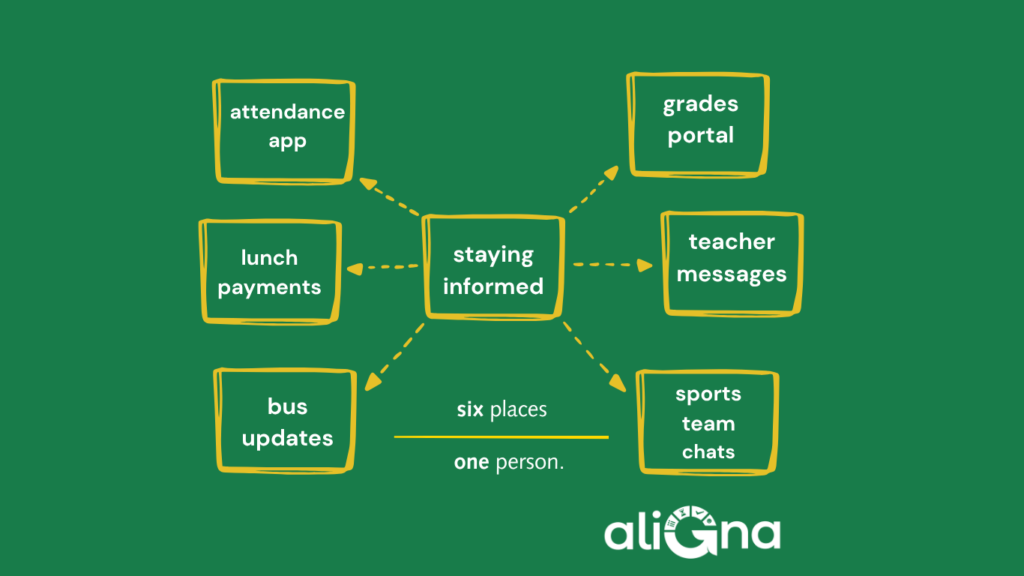
The attendance portal.
The grade app.
The lunch account.
The teacher messaging system.
The sports platform.
The class group chat.
You can buy every item on the school-supply list in an afternoon.
What you can’t buy is the bandwidth to run the year that list sets in motion.
Because a checklist records the doing.
And the doing is often the smallest part.
Why does one line on a checklist take up so much room?
Take one ordinary line:
Prepare for the first day of school.
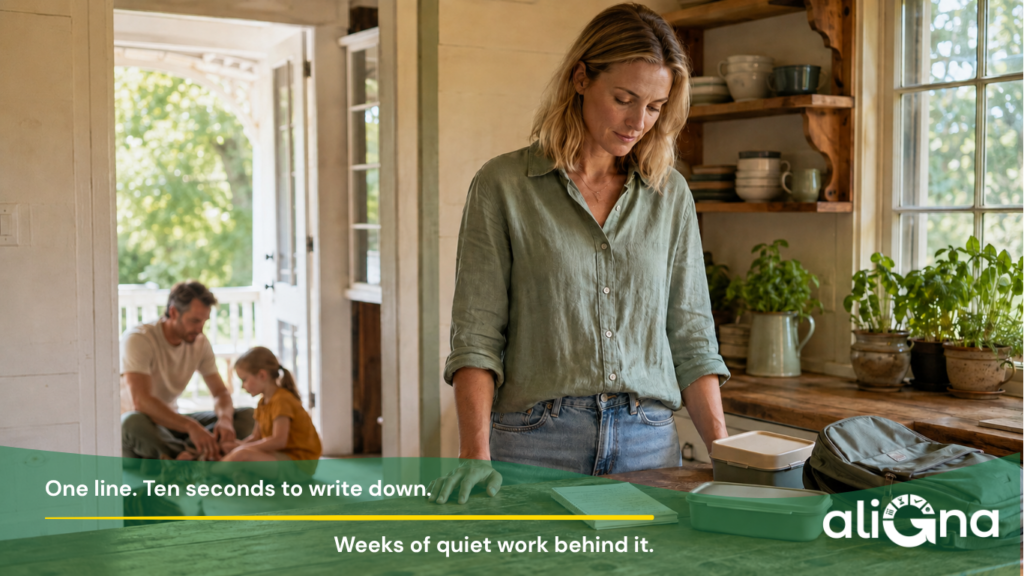
Ten seconds to write down.
But before anyone checks it off, someone has already started thinking.
Will last spring’s shoes still fit?
Has the supply list been posted?
Did we complete the health form?
What time is pickup this year?
Does soccer overlap with after-school care?
Which child needs the nut-free lunch?
Where did the teacher say to find that form?
This is the part of household work that rarely makes it onto the list.
Research on cognitive labor helps explain why. Sociologist Allison Daminger has described four stages of invisible household work: anticipating needs, identifying options, making decisions and monitoring what happens next.
In everyday family life, remembering runs through all four.
You anticipate that something will be needed.
You figure out what needs to happen.
You decide how your family will handle it.
Then you keep enough of it in your head to notice whether it actually got done.
Four kinds of work can sit behind one visible task.
That gap between how a task looks on paper and how it feels to carry is where much of the school year is actually run.
What is “administrative parenting”?
There’s also a newer layer of mental load that barely existed in its current form a decade ago.
It’s sometimes described as administrative parenting: the work of managing a child’s life through the portals, passwords, forms, notifications and digital systems that now sit between a parent and a simple piece of information.
The permission slip isn’t necessarily in the backpack anymore.
It might be in an email linking to a portal requiring a password you haven’t used since May.
The game schedule might be in one app.
The teacher update in another.
The lunch balance somewhere else.
None of these tools is inherently the problem. Each is usually designed to make one part of school communication easier.
The load appears when families become the integration layer between all of them.
Recent reporting on parents navigating school communication has described the experience as a kind of scavenger hunt: staying informed becomes not only about understanding the information, but remembering where to look for it.
That remembering is work.
Why does back-to-school now come with so many logins?
Because school information rarely arrives in one place anymore.
A family might use one system for attendance, another for grades, another for lunch payments, another for teacher communication and another for sports or extracurricular activities.
Research into K–12 app use has found that some schools without unified platforms expect families to navigate roughly 10 to 15 separate educational apps.
Every system may solve a legitimate problem.
Together, they create another one:
someone has to remember where everything lives.
And when every notification arrives looking urgent, urgency itself becomes another decision.
Which message needs action tonight?
Which can wait?
Was the field-trip form in the email or the portal?
Did the payment actually clear?
Was that schedule change added to the family calendar?
So someone ends up carrying a running mental index of the school year:
where to look, what matters, what changed, what still needs doing and who else needs to know.
No checklist has a line for maintaining that index.
Which is precisely why it is so easy for one person to carry it alone.
The relationship work no app tracks
There’s another layer of school-year work that technology can’t really capture at all.
Someone in your household is quietly maintaining relationships.
With the teacher.
With the front office.
With the parents of your child’s closest friends.
With the neighbor who can occasionally help at pickup.
It’s replying in the class group chat.
Remembering which family you owe a ride to.
Knowing who to text when your child comes home unsettled and you’re trying to understand what happened.
Remembering that a friend’s parent mentioned something important three weeks ago.
None of that appears on the school-supply list.
But all of it contributes to something families care deeply about:
your child being known.
Known by the teacher.
Known by other families.
Known as more than a name on a roster when something goes wrong.
That takes attention.
And attention is finite.
No school portal has a field for this kind of relational work — which is one reason it remains so easy to overlook.
Why can both partners feel like they’re carrying more?
Because invisible work is much easier to see when it is happening inside your own head.
Ask two adults in the same household how much of the family’s mental load they carry and their answers may add up to considerably more than 100%.
One survey of 2,005 U.S. parents found primary caregivers estimated that they carried 75% of the mental load, while non-primary caregivers estimated their share at 56%.
Together: 131%.
That doesn’t necessarily mean anyone is being dishonest.
Each person can see their own anticipation, remembering, decisions and follow-up clearly.
What’s harder to see is the identical chain of thinking happening in someone else’s head.
Separate research into household cognitive labor has found a similar perception gap: when work is difficult to observe, people can overestimate their own contribution and underestimate what their partner is carrying.
Sometimes the underlying issue is an unequal division of work.
But before a family can even have that conversation clearly, there is often another problem:
the work itself isn’t visible.
So two people can both be doing a great deal.
Both can feel stretched.
And both can still feel unseen.
Visibility doesn’t solve every fairness problem.
But it gives families something concrete to solve together.
How do you actually share the back-to-school mental load?
Not by creating a longer checklist.
Start by making the whole season visible before you divide it.
1. Make the season visible
Look at the next four to six weeks together.
Not only:
- buy supplies
- fill out forms
- pack lunches
- arrange transportation
Also capture the work surrounding those tasks:
What needs noticing?
What needs deciding?
What has to be remembered?
What will need checking again later?
Most families discover the real list is much larger than either person expected.
That realization is useful.
The goal isn’t to prove who has been doing more.
It’s to finally see what the household has actually been running.
2. Share ownership, not errands
There is a difference between completing a task and owning an area.
“I’ll pick the kids up Tuesday” is a task.
“I’ll own school transportation” is ownership.
Ownership means knowing the route, watching for timing changes, managing pickup arrangements, communicating changes and noticing when something stops working.
“I’ll buy lunch supplies” is a task.
“I’ll own school lunches” means knowing what each child needs, noticing what is running low and replenishing it before Wednesday morning becomes an emergency.
The invisible work belongs inside the ownership too.
Tasks can be delegated. Ownership includes remembering what comes next.
3. Decide where important information will live
You may not be able to control how many systems your school uses.
But you can decide what happens after information enters your household.
If four platforms feed your family information, decide:
Who checks what?
What information needs to leave that platform?
Where do deadlines, events and decisions go so everyone can see them?
The goal isn’t to create another place you have to remember to check.
It’s to create a shared source of truth so the family stops depending on one person’s memory.
Your family doesn’t need a perfect first week
There will still be a forgotten water bottle.
A portal password will expire at exactly the wrong moment.
A teacher will send something after you thought the week was settled.
A practice will move.
Someone will remember the spirit-day outfit at 8:13 p.m.
Family harmony isn’t built by eliminating every one of those moments.
It’s built when the whole picture is visible enough that no one has to quietly hold all of it alone.
Because you can’t share what you can’t see.
And once you can see it, you can finally decide how to carry it together.
Frequently Asked Questions
What is back-to-school mental load?
Back-to-school mental load is the invisible thinking required to prepare for and manage the school year. It includes anticipating what children will need, finding information, remembering deadlines, coordinating schedules, making decisions and following up after visible tasks are completed.
What is administrative parenting?
Administrative parenting describes the growing work of managing children’s lives through digital systems such as school portals, messaging platforms, payment systems, online forms and activity apps. The work isn’t only completing what arrives — it also includes remembering where information lives and deciding what needs attention.
Why does back-to-school feel harder than the checklist looks?
Because a checklist usually captures only visible actions. Behind those actions is cognitive work: anticipating needs, researching options, remembering details, making decisions and monitoring what happens next. Fragmented school communication adds another layer by spreading information across multiple apps and accounts.
Why do schools use so many different apps?
Schools and individual departments often use specialized tools for different needs, including attendance, grades, payments, messaging and extracurricular activities. Each tool may simplify one function, but using many systems together can leave families responsible for tracking where different information lives.
How can couples share the mental load of school?
First, make the invisible work visible together — including planning, noticing and follow-up, not only errands. Then divide responsibility by complete areas of ownership, such as transportation or lunches, rather than assigning isolated tasks. Finally, decide where important school information will live so both partners can see it.
What’s the difference between helping and owning?
Helping means completing a task someone else has already noticed, planned or assigned. Owning means taking responsibility for the entire cycle: noticing what needs attention, planning ahead, making decisions, completing the work and monitoring what comes next.
About Aligna
Running a household isn’t just about completing tasks.
It’s about carrying everything that happens before and after the task — the anticipating, remembering, deciding, coordinating and following up that often lives inside one person’s head.
That’s the idea behind Aligna: giving families one shared place to make invisible work visible, share ownership and keep the information that runs family life from living in one person’s memory.
Because the answer to app overload shouldn’t simply be one more app to check.
It should be a calmer way for the household to understand what needs attention, who owns it and what comes next.
Join the Aligna Beta Community and help us build a more visible, connected way to carry family life together.
Explore more on mental load
The Mental Load Doesn’t Go Back to School. It Just Changes Shape.
Why the load never really starts or stops — it changes with the season.
You Can’t Support What You Can’t See
Why visibility is the first step toward genuinely sharing invisible work.
Why Family Task Apps Fail (And What Actually Reduces Mental Load)
Why another list isn’t always the answer — and what families actually need from shared technology.
How to Plan Your Month as a Family (Without the Last-Minute Panic)
How to build a planning rhythm the whole household can see.